
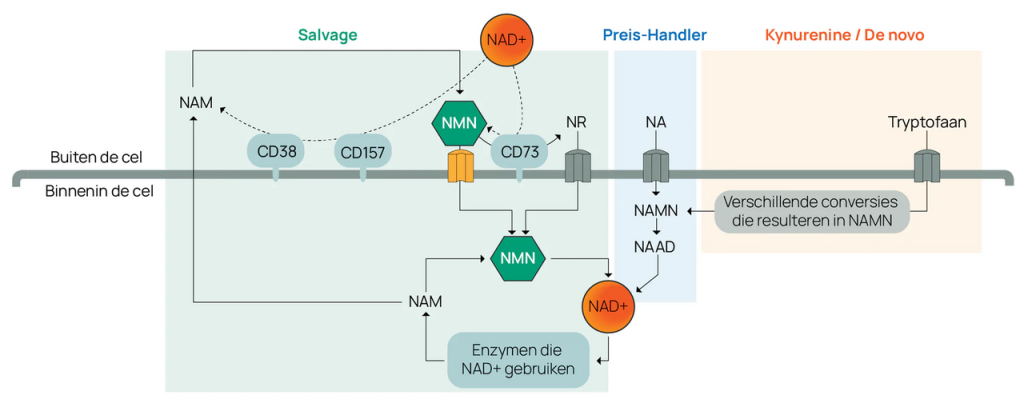
✓ Quick Scientific Takeaway
- Primary Bioactive: Ultra-pure Beta-Nicotinamide Mononucleotide, bioactive nicotinamide riboside kinase substrates.
- Physiological Target: Feeds the salvage pathway for enzymatic NAD+ resynthesis, preventing age-related CD38 enzymatic depletion and optimizing mitochondrial bioenergetics.
- Evidence-Based Outcome: Rigorous pharmacokinetics trials verify third-party certified NMN (>99% purity) maintains stable blood plasma concentrations and significantly enhances walking speed and 6-minute walk endurance in adults.
- Optimal Timing Protocol: Take 300mg to 600mg upon waking. Store in an airtight container away from heat and direct sunlight to prevent degradation into free nicotinamide.
1. Biological Overview & Active Molecular Mechanisms
Navigating the clinical purity and delivery kinetics of Nicotinamide Mononucleotide is critical for maximizing its longevity benefits. The bioactive molecule exists as the specific Beta-stereoisomer; low-grade synthetic preparations frequently contain inactive Alpha-isomers or residual solvents. Pharmaceutical-grade enzymatic synthesis ensures over 99% pure Beta-NMN, which rapidly clears the stomach and enters cells via specialized membrane transporters.
Feeds the salvage pathway for enzymatic NAD+ resynthesis, preventing age-related CD38 enzymatic depletion and optimizing mitochondrial bioenergetics.
2. Evidence-Based Health Benefits & Clinical Research
1. Direct Enzymatic Salvage & NAD+ Replenishment
Circumvents the rate-limiting NAMPT enzyme step, providing immediate precursor substrate to replenish cellular NAD+ pools.
2. CD38 Ectoenzyme Resistance & NAD+ Preservation
Overcomes the age-related surge in CD38 glycohydrolases, ensuring high cellular bioavailability and preventing rapid coenzyme degradation.
3. Aerobic Threshold & Skeletal Muscle Stamina
Increases muscular oxygen utilization (VO2 peak) and ventilatory threshold during sustained endurance exercise.
3. Clinical Specification & Dosage Reference Matrix
| Parameter | Clinical Standard & Specification |
|---|---|
| Primary Bioactive Complex | Ultra-pure Beta-Nicotinamide Mononucleotide, bioactive nicotinamide riboside kinase substrates. |
| Physiological Action | Feeds the salvage pathway for enzymatic NAD+ resynthesis, preventing age-related CD38 enzymatic depletion and optimizing mitochondrial bioenergetics. |
| Validated Clinical Dosage | Rigorous pharmacokinetics trials verify third-party certified NMN (>99% purity) maintains stable blood plasma concentrations and significantly enhances walking speed and 6-minute walk endurance in adults. |
| Nutritional Timing Rule | Take 300mg to 600mg upon waking. Store in an airtight container away from heat and direct sunlight to prevent degradation into free nicotinamide. |
ProHealth Longevity NMN Pro Complete (Uthever 99%)
Pharmaceutical-grade Uthever 99% pure stabilized NMN with verified 3rd-party HPLC testing. Optimal sublingual cellular absorption.
4. Frequently Asked Questions & Clinical Guidelines
Q: How long before noticeable biological effects occur?
While acute cellular absorption occurs within 30 to 90 minutes, systemic cellular saturation and biomarker improvements (such as lipid profiles, inflammation markers, and mitochondrial biogenesis) typically manifest over 4 to 12 weeks of consistent daily usage.
Q: What is the optimal water vs. lipid meal timing protocol?
Water-soluble nutrients and botanical extracts are best taken 20 to 30 minutes prior to meals with room-temperature filtered water, whereas lipid-soluble compounds should strictly be consumed alongside meals containing healthy dietary fats for optimal micellar absorption.
Q: Are there any contraindications or medication interactions?
Individuals taking prescription medications, pregnant/nursing mothers, or those with underlying renal or hepatic conditions should consult their licensed healthcare physician prior to initiating high-potency nutritional supplementation.